Seventeen Hours Ahead
Kickoff at the MCG is 10:35 on Friday morning. In Los Angeles it's 5:35 on Thursday evening. Only one of these teams wants their bodies to know that.
The NFL's first game in Australia has produced something more interesting than the game itself: a natural experiment. The 49ers flew out on September 2 and landed on the 4th, a full week before kickoff and nine days door to door once you account for the flight. The Rams leave Wednesday US time, land Thursday, play Friday morning, and fly home straight after. Roughly 24 hours on the ground. Two franchises, same 15,000 km trip, completely opposite answers to the same question.
What the research actually says
The 49ers did their homework the conventional way: sleep scientists, sports science consultants, the lot. And the conventional homework is real. A 2026 systematic review pulling together 89 studies on long-haul travel in athletes (Benito et al., Sports) found the same cluster of problems over and over: fatigue reported in 25 studies, sleep disruption in 21, measurable drops in physical performance in 18, mood changes in 15, cognitive effects in 9. The performance hits show up across the board, from anaerobic power and strength through velocity, aerobic capacity, coordination and reaction time.
The recovery timeline backs the week-long stay too. The standard clinical rule of thumb, going back to Samuels (2012) and Lee & Galvez (2012), is that jet lag resolves at roughly one day per time zone crossed, with the direction mattering: westward shifts (extending your day) resolve at about half a day to a day per hour, eastward (compressing it) closer to a day and a half. Melbourne sits 17 hours ahead of LA, which the body treats as a 7-hour westward shift. Call it four to seven days to fully resync. Core temperature and hemodynamic rhythms take about a week to normalise too, with individual recovery ranging from 3 to 11 days. The 49ers' stay isn't a vibe; it's the textbook number. And a 2025 critical review by Botonis and colleagues found subjective sleep quality and general well-being stay suppressed for two to six days after long-haul arrival, which is more or less what Kyle Shanahan said in press conferences: you don't feel normal until the third or fourth day. San Francisco will run out on Friday fully synced to Melbourne time.
Which is precisely where it gets interesting.
The Rams aren't ignoring the science, they're reading a different page of it
Nearly everything in your body runs on a 24-hour cycle, and the performance-relevant markers (core temperature, strength, power output) peak in the late afternoon, around 6pm. A fully acclimated athlete playing at 10:35am is playing hours before that peak. A morning body.
Now run the Rams' plan through the same framework. Stay on Pacific time, sleep on the plane, never adapt. When the ball is kicked at 10:35am Melbourne time, every Rams body clock reads 5:35pm Thursday, sitting almost exactly on the circadian peak. The 49ers spent a week and considerable expense adapting into a morning kickoff. The Rams are trying to smuggle a late-afternoon body into the same game.
Direction matters here too, though not as tidily as you'd hope. Physiologically, eastward travel (compressing your day) produces stronger circadian disruption than westward, where you extend it, and this trip is westward-equivalent. That's the forgiving direction for the body clock, and the best possible flight on which to attempt the no-acclimation plan. But the same 89-study review complicates the story: when researchers looked at actual game statistics across the NBA, NFL, NHL and MLB, westward travel was frequently the direction linked to poorer team outcomes, contrary to the standard jet-lag assumption. The review's own conclusion is that direction alone doesn't determine anything; it's the interaction of circadian phase, kickoff timing and travel stress. Which, conveniently for the Rams, is exactly the interaction they're trying to engineer.
There's precedent. The Rams ran the day-before plan into London last season against the Jaguars, a team with years of established early-arrival routines, and won comfortably, with Davante Adams catching four touchdowns. One game is an anecdote, not a finding. But it's the reason McVay spent a month refusing to discuss the itinerary.
The catch
The same body of research cuts against the Rams in one important way: travel itself degrades performance independent of time zones crossed. Lee & Galvez draw the distinction cleanly. Jet lag is circadian desynchronisation, while travel fatigue is its own thing: the flight, the disrupted routines, the dehydration, the plane-seat posture. Doherty et al. (2023) found time in bed, total sleep and sleep efficiency all reduced for about 48 hours after long-haul travel, whatever your watch says. Sixteen hours folded into a charter and one compressed night in an unfamiliar hotel; no amount of circadian arithmetic makes that disappear. The Rams' plan only works if the flight goes cleanly. There's no buffer. A delayed departure, a poor night's sleep on board, and they're playing the most-travelled road game in NFL history on fumes.
Here's the part nobody mentions
When I went looking for the study that settles this, a direct comparison of day-before arrival versus week-early arrival in athletes, I couldn't find one. It doesn't appear to exist. The literature has the one-day-per-time-zone rule, post-travel sleep monitoring, HRV tracking during acclimatisation, and a 2021 consensus statement (Janse van Rensburg et al.) that concedes there's little high-quality evidence for managing any of this in athletes. What it doesn't have is a head-to-head trial of the exact question the Rams and 49ers are about to answer.
Both teams consulted experts. Both teams can cite research. Neither plan has actually been tested against the other, because Friday at the MCG is the test. Two elite rosters, same opponent quality, same venue, same kickoff, opposite protocols. Sports science departments will be citing this game for years.
What the market thinks
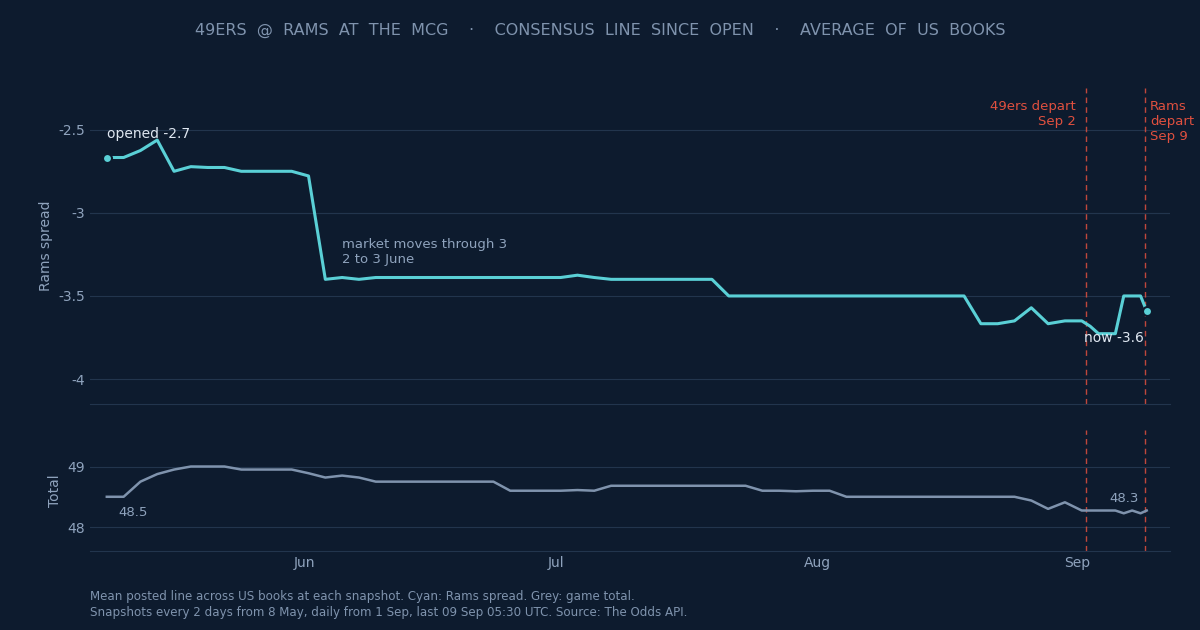
The line opened on 8 May at Rams -2.5 at DraftKings and BetMGM, with Caesars at -3. Three US books, one game on the board, four months out. It sat there for most of May. Then over the first days of June, almost every book moved through the key number of 3 to Rams -3.5, and it has not come back. Vig removed, that took the Rams from a 58 percent chance to 62. Today the consensus is -3.5 with a few books at -4, and the Rams sit at roughly 65 percent. The total has barely breathed: 48.5 at the open, 48.3 now, after a summer wobble up to 49.
Now put the travel dates on that chart. The 49ers left on 2 September. Over the next two days the line moved less than a tenth of a point. A handful of books drifted to -4, then came back to -3.5 by 6 September. The Rams' itinerary going public did nothing either. Net move since May is a point toward the Rams, and nearly all of it happened in June, three months before anyone boarded a plane.
So the data does not support a travel story. The market priced the Rams as the better team in June and has treated the two flight plans as either priced in or irrelevant ever since. Australian books agree, if anything a touch more Rams-heavy: Sportsbet and PointsBet have it at -4.5.
What I'll be watching
Not the final score. One game can't settle this, no matter who wins. The tells are earlier: does the Rams' offence look crisp on the opening two drives, when a circadian-peak body should show up? Do the 49ers fade or hold late, when a week of adaptation should pay off? And does the market move on any of it? Because if the Rams win doing this twice in two years, day-before arrival stops being a McVay eccentricity and becomes a strategy other teams copy, and a pricing input the rest of us have to model.
Someone's sports science department is getting a very awkward review on Monday.
Sources
- Benito, A., Boppre, G., Lopes, A., Cruz, D., Moreira-Gonçalves, D., Pyne, D.B., Baptista, L.C. & Zacca, R. (2026). Do Long-Haul Travel and Jet Lag Affect Athletes' Physiological, Humoral and Performance Outcomes? A Systematic Narrative Review. Sports, 14(3), 93. doi:10.3390/sports14030093
- Botonis et al. (2025). Impact of long-haul airline travel on athletic performance and recovery: A critical review of the literature. Experimental Physiology.
- Janse van Rensburg et al. (2021). Managing travel fatigue and jet lag in athletes: a review and consensus statement. British Journal of Sports Medicine.
- Doherty et al. (2023). Post-travel sleep outcomes in athletes (time in bed, total sleep time, sleep efficiency reduced ~48h post-travel).
- Lee, A. & Galvez, J.C. (2012). Jet Lag in Athletes. Sports Health.
- Samuels, C.H. (2012). Jet lag and travel fatigue: a comprehensive management plan for sport medicine physicians and high-performance support teams. Clinical Journal of Sport Medicine.
- Historical odds via The Odds API (the-odds-api.com), snapshots 8 May to 9 Sep 2026.